
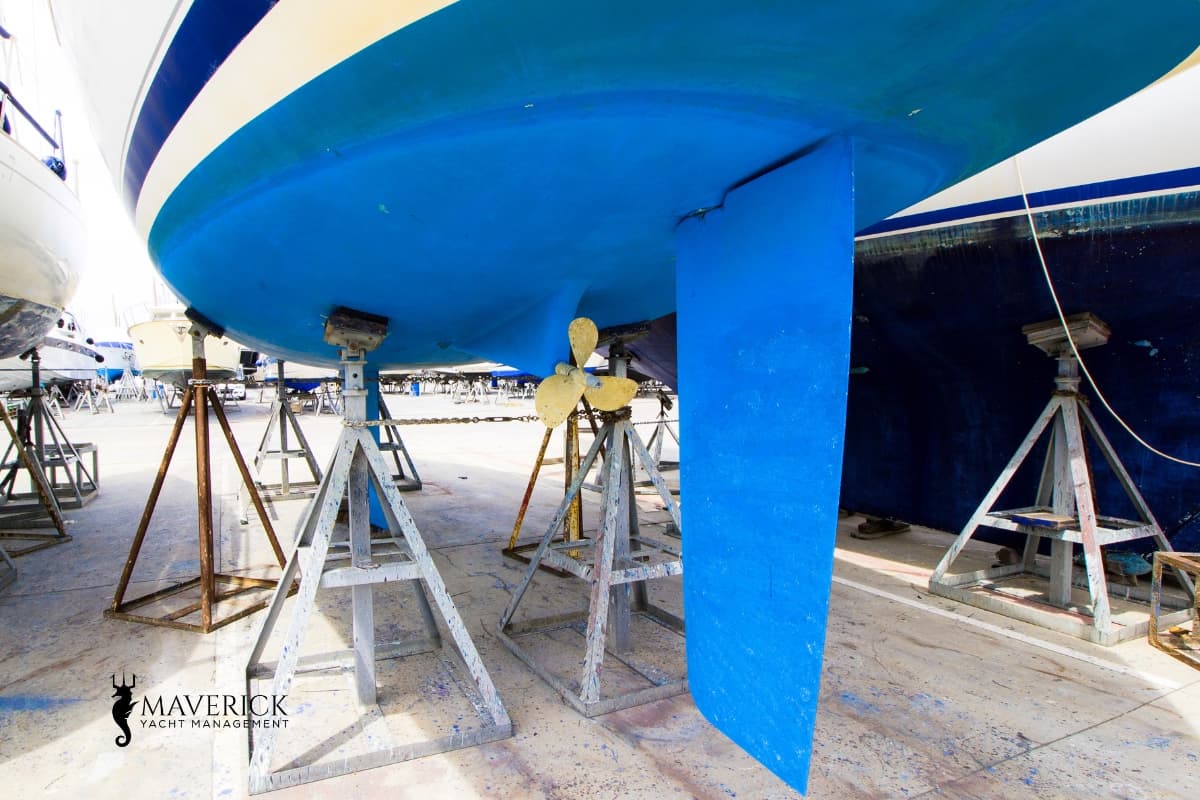
Bottom Paint, Biofouling, and the $10,000 Mistake Most Owners Make Before Summer
Summer in Fort Lauderdale means full marinas, packed waterways, and yacht owners who spent months looking forward to getting back on the water. For many of them, the first trip of the season reveals something they were not expecting: a vessel that runs sluggishly, burns more fuel than it should, and sits in a haul-out queue waiting for a problem that should have been handled months ago.
Bottom paint and biofouling are among the least glamorous topics in yacht ownership. They are also among the most financially consequential — particularly for South Florida owners whose vessels sit in warm, shallow water year-round. One missed service window or one wrong paint selection can quietly set the stage for a repair bill that clears five figures before summer even gets started.
What Biofouling Actually Is — And Why South Florida Accelerates It
Biofouling is the accumulation of marine organisms on a vessel's submerged surfaces. Barnacles are the most visible culprit, but the process begins with microbial biofilm — a layer of bacteria and microalgae that attaches within hours of a hull entering the water. Slime, then soft growth, then hard organisms follow in sequence. Left unchecked, the result is a hull covered in layers of living material that adds significant drag and weight.
South Florida's warm, nutrient-rich inshore waters create near-ideal conditions for fouling organisms. Water temperatures that stay well above 70 degrees Fahrenheit year-round allow barnacle larvae to settle and attach aggressively on untreated or under-protected hull surfaces. Fort Lauderdale vessels that sit in slips between owner visits accumulate growth at a rate that would be notable even in summer conditions further north — and here, those conditions exist in January.
A vessel with six months of unchecked biofouling can carry 150 to 200 pounds of additional underwater growth. The drag penalty is not theoretical — fuel consumption on a fouled hull routinely increases 20 to 30 percent compared to a clean one.
The $10,000 Mistake — And How Owners Keep Making It
The most expensive biofouling mistake is not skipping bottom paint entirely. Owners who skip it entirely know they are skipping it. The costlier pattern is subtler: applying bottom paint on the wrong schedule, selecting the wrong paint system for actual usage patterns, or assuming last season's coat still has meaningful life left.
Here is how the math unfolds in a typical scenario.
An owner hauls out in October, applies a standard hard antifouling paint, and returns to Fort Lauderdale in May. Seven months of South Florida water have largely exhausted the biocide in that paint. Growth attaches progressively from February onward. By the time the owner arrives for the summer season, the hull requires a pressure wash at minimum — and frequently a full haul-out and paint job that was not budgeted.
Now add what was running underwater for those final months: engines working harder than designed against sustained drag, fuel consumption elevated across every trip taken in the interim, and a potential survey impact for anyone considering selling the vessel in the near term. What started as a paint scheduling oversight has compounded into a situation touching fuel costs, mechanical wear, and market value simultaneously.
Emergency haul-outs during peak season carry real pricing premium. Service yards in the Fort Lauderdale area fill quickly before summer, and expedited scheduling reflects it. Professional bottom painting and antifouling service coordinated in advance — on the right schedule for South Florida conditions — consistently costs a fraction of what reactive service demands.
Choosing the Right Antifouling System for South Florida
Not all bottom paint is built for warm-water, year-round submersion environments. Owners who relocate vessels seasonally or who purchase paint based on northern usage recommendations frequently find themselves with an inadequate system for what South Florida's water actually delivers.
Ablative (self-polishing) antifouling paints are generally better suited to vessels in active use in South Florida. The biocide releases gradually as the hull moves through water, meaning performance tracks with usage rather than depleting at a fixed rate regardless of how often the boat moves. For owners who cruise regularly, ablative systems maintain meaningful protection throughout a longer service interval.
Hard contact-leaching paints release biocide through water contact rather than hull movement. In South Florida's warm water, this means depletion can occur faster than the label suggests, particularly on vessels docked in exposed or tidal locations. Hard paints also build up with successive applications, creating a removal obligation that adds cost at future haul-outs.
Copper-free systems are gaining traction in South Florida as environmental regulations evolve and technology improves. Performance in warm water has improved substantially in recent formulations, though proper surface preparation remains critical for adhesion and efficacy.
Matching the right system to the vessel's usage pattern — how often it moves, where it sits, how long between haul-outs — is a judgment call that benefits from professional yacht maintenance input from someone familiar with Fort Lauderdale's specific marine conditions.
What a Proper Haul-Out Service Includes
Bottom paint is only as effective as the preparation underneath it. A haul-out performed correctly covers pressure washing, hull inspection for osmotic blistering and through-hull integrity, surface preparation to manufacturer specifications, and antifouling application in the right coat count for the vessel's size and exposure profile.
Running gear — propellers, shafts, trim tabs, and cutlass bearings — should be inspected during every haul-out. Owners who skip running gear assessment are leaving the most mechanically stressed underwater components unexamined at the one moment when doing so costs nothing additional.
A managed vessel arrives at the yard with documentation from the prior haul-out, clear service notes, and a provider who already knows the boat. That context saves time, improves quality, and reduces the likelihood of anything consequential being missed.
Why Pre-Summer Is the Highest-Stakes Window
Fort Lauderdale's summer season concentrates demand on service yards and haul-out facilities in a short window. Owners who schedule proactively — ideally in February or March for a May readiness target — secure calendar priority, competitive pricing, and enough lead time to address anything found during the haul-out without disrupting summer plans.
Owners who wait until April or May find a different situation. Haul-out slots are limited. Technicians are booked. Lead times for specialty coatings and running gear parts extend. A vessel that should have been in and out of the yard in a week can sit waiting for scheduling while the season moves forward without it.
Hurricane season adds urgency from the opposite direction. A vessel with documented underwater maintenance goes into hurricane season in a structurally stronger position than one carrying deferred underwater service. Hurricane protection planning and bottom paint scheduling are more directly connected than most owners recognize — both are about protecting the asset before conditions make protection harder to execute.
What Professional Management Changes About This Process
Owners managing their own haul-out scheduling frequently discover the problem after it has already developed. A managed vessel does not wait for an owner visit to reveal growth or surface degradation — regular underwater inspections and documented service intervals mean the haul-out happens when the hull needs it, not when the owner happens to notice something is wrong.
Maverick Yacht Management coordinates bottom painting and antifouling service as part of a structured vessel care program, scheduling with vetted Fort Lauderdale yards in advance, maintaining haul-out history, and ensuring the right paint system is selected for each vessel's specific profile. Owners receive a vessel that is ready for summer — not one that arrives at summer requiring it.
Contact Maverick Yacht Management before the pre-season rush to discuss a haul-out and bottom paint program for your vessel.
Frequently Asked Questions
Q: How often does a yacht need bottom paint in Fort Lauderdale?
A: Most Fort Lauderdale vessels require haul-out and bottom paint service annually, with some high-use vessels or those in particularly exposed slips needing attention every 10 to 12 months. South Florida's warm water accelerates biocide depletion faster than northern environments, meaning paint systems that perform well for 18 months in cooler climates may require replacement within a year here.
Q: What is the real cost of biofouling on a South Florida yacht?
A: Direct costs include the haul-out, cleaning, and repaint itself — typically ranging from several thousand dollars upward depending on vessel size and condition. Indirect costs include elevated fuel consumption over the fouled period, increased mechanical wear on engines working against sustained drag, and potential survey impact on vessels carrying visible growth or deferred underwater service history.
Q: What is the difference between ablative and hard bottom paint for South Florida?
A: Ablative paint releases biocide gradually as the hull moves through water, making it well-suited to vessels in regular use in South Florida. Hard paint releases through water contact regardless of vessel movement, which can lead to faster depletion in warm, active marine environments. Paint selection should account for how often the vessel is used and how long it sits between haul-outs.
Q: Can biofouling damage the hull itself?
A: Extended biofouling creates conditions favorable to osmotic blistering, accelerates corrosion around fittings and through-hulls, and can obscure gelcoat damage that would be caught earlier under a clean hull inspection. Barnacles themselves do not penetrate fiberglass, but their attachment and removal — particularly if abrasive methods are used carelessly — can compromise surface integrity over time.
Q: How far in advance should I schedule a haul-out before summer in Fort Lauderdale?
A: February or March is the practical window for owners targeting May readiness. Fort Lauderdale service yards and haul-out facilities face high demand from April onward, and scheduling in advance secures both calendar priority and pricing that reflects planned rather than emergency service. Owners who wait until late spring regularly find limited availability and extended lead times.
Need help with your vessel?
Maverick offers free on-vessel inspections. We walk your boat, assess her condition, and send you a plan — no obligation.
Talk to a captain, not a call center.
Free vessel assessments. No commitment.
Request an Inspection (954) 799-5870